There are 16 elder care workers in the diocese, working to organise events in local parishes and supporting older adults in the communities. When talking to these lovely people working in the older person care space, it’s remarkable how they all work so differently and use their God-given talents in their parish and wider communities.
Nicola is one of these people.
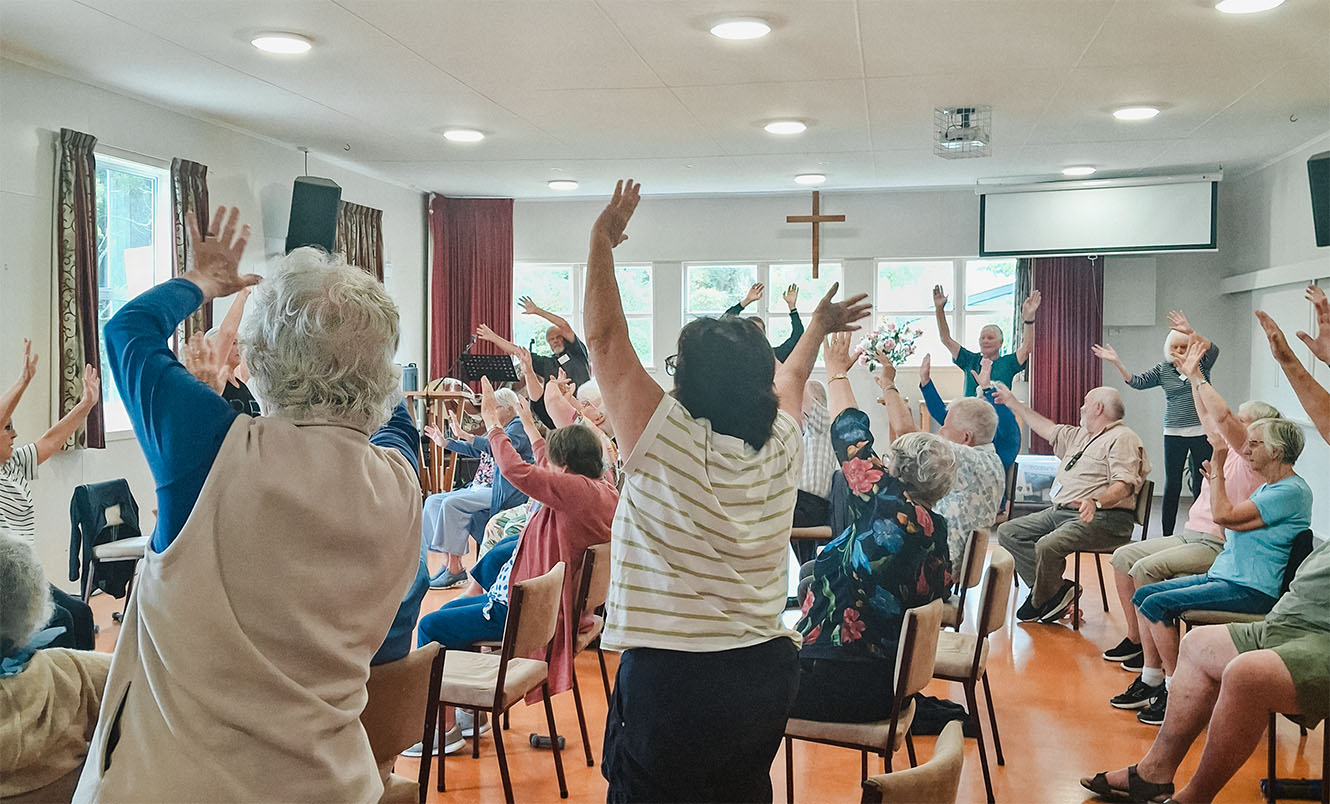
She invited me to the St Paul’s Exercise and Games group in Brightwater one Thursday morning. I was running late so missed the happy birthday song being sung to a participant, who treated us to lovely sausage rolls. They were having fun talking. I quietly joined in with the exercises – some sitting, some standing, as volunteers looked after people and helped them with versions of the exercises that suited them, and themselves joining in and belting out ABBA. The joy was tangible.
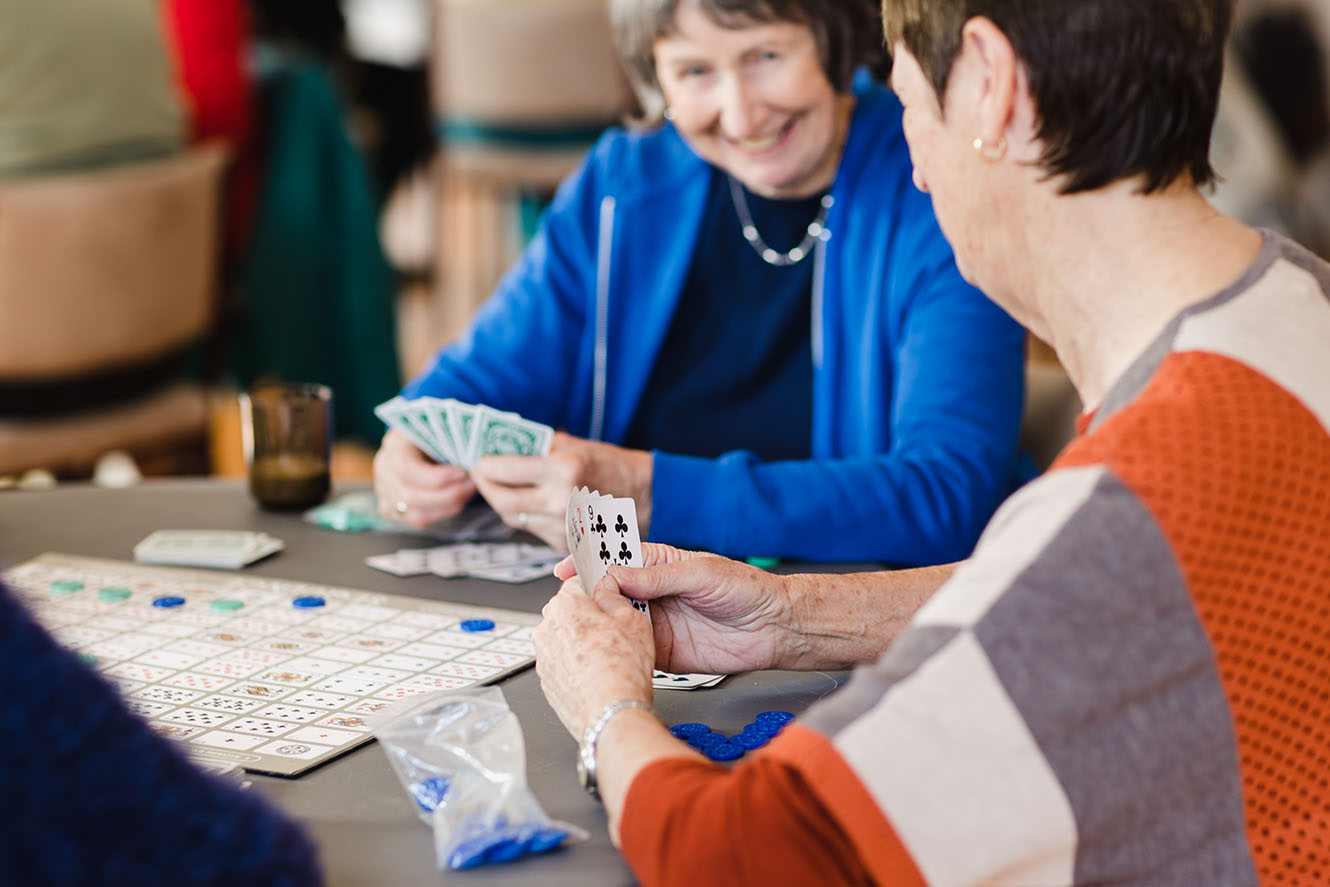
After exercises, the games come out – Bingo, Rummikub and cards. I joined a table and was taught how to play Rummikub and, at the same time, help a blind neighbour play and find all the chocolate biscuits on the plate. It was great to see people connecting and helping each other, all the while enjoying morning tea, cake and sausage rolls.
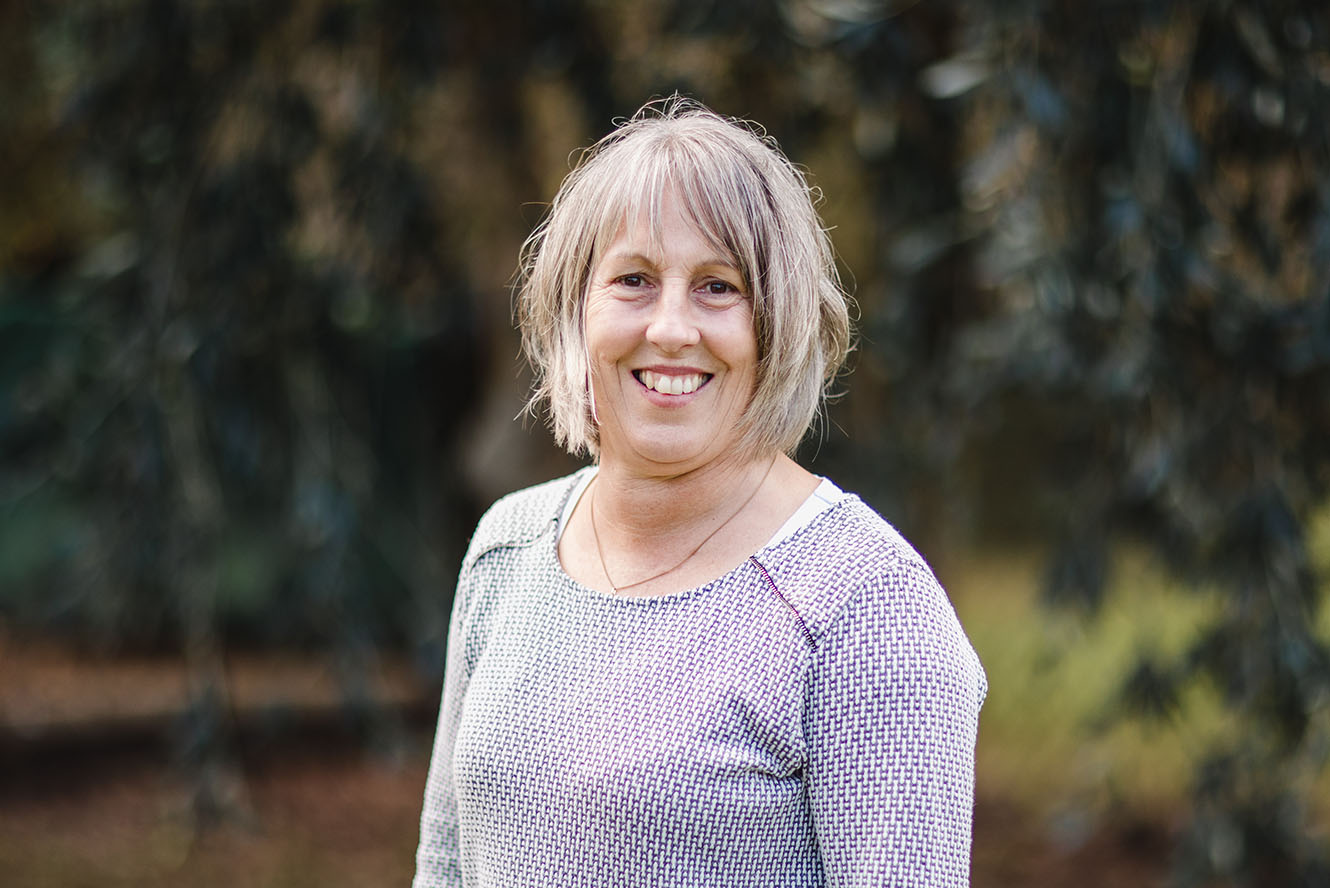
Afterwards, Nicola kindly allowed me to interview her for Kōrero.
Nicola: I am married with three adult children. One lives overseas, while the other two are still at home – though I imagine they will eventually move out! I often joke with them that if they don’t, I’ll simply move in with them when I get older.
My parents also live locally. My father is now living with the start of dementia, and this season has allowed me to draw on the experience I’ve gained over the years working with older people. I am able to support him, as well as encourage and care for my mother along with the help of my sisters.
I first became involved in the Anglican Church as a helper in the Music and Rhythm programme at St Paul’s. I loved it so much that it became my home church. Over time, I transitioned from serving tea to leading the sessions, a role I held for around 18 years before stepping down about six years ago.
Although I became a Christian in a Baptist church, I was baptised at St Paul’s, and I have remained there ever since – I often say I’m part of the furniture!
Nicola: I am the Waimea Anglican senior care coordinator, serving the communities of Brightwater and Wakefield. My role is varied, and I support wherever there is a need.
Much of my work is both church and community-focused. While it is wonderful to support parishioners in whatever they may need, my primary focus is reaching those in the wider community – particularly those who may feel disconnected or isolated. This is why we run various programmes.
We have welcomed many people who do not identify as Christians, yet they still consider the church their home. At times, families have contacted me after a loved one has passed away, sharing that the church was meaningful to them and asking if the funeral could be held there. It is truly a place where people feel loved and accepted.
Our programmes also support families caring for loved ones with dementia or disabilities, offering a form of respite care. Over time, we often see deeper connections form – sometimes individuals begin attending because their spouse or loved one did, and they continue even after loss of a loved one. This is especially important for those experiencing isolation as well.
Connection is at the heart of everything we do. The Exercise and Games group, in particular, has become like a family. Members take ownership – they set up, pack down the tables, and care for one another. Even when I am away on holiday, some still meet for coffee together on a Thursday at the Brightwater HQ cafe, to connect.
One of our much-loved members, who was 98, enjoyed playing Rummikub so much that she started her own Saturday group at home, affectionately calling it the “youth group”. I was occasionally invited, which was very special.
What began as a small initiative has grown significantly, extending into the wider community. These relationships also allow me to connect with people more personally through home visits.
Some members of the group are not Christians, yet they are still comfortable participating when I share devotions. While I don’t consider myself a theologian, I hope that through these moments – whether through reading, conversation, or questions – people encounter something meaningful and the love of God. Some even choose to attend our Exercise and Games Bible study I organise, where we support each other in learning about Jesus and exploring questions we may have.
Nicola: I have been involved in this work for around 14 years. At times I wonder if people might grow tired of the routine, but when I once asked whether things needed refreshing, the response was clear: routine is valued and comforting.
That said, there are always moments of spontaneity. Sometimes changes happen unintentionally – perhaps I play the wrong song or misplace something – but these moments often bring joy. On one occasion, a gentleman requested a particular piece of music, which turned out to be the “Can Can”. We played it on the spot and had a lot of fun, though we haven’t repeated it since!
I truly see this work as a gift from God.
I often joke that I don’t have friends my own age anymore – only older friends. Some even feel comfortable enough to visit me at home, which speaks to the trust and connection we’ve built.
Nicola: Ministry to older people is incredibly important, particularly in communities where transport can be a challenge. Even something as simple as getting to a bus stop can be difficult, so having accessible, local opportunities for connection is vital.
For example, St John’s in Wakefield hosts a community lunch where people can share a home-cooked meal and enjoy fellowship. Sitting down and eating together is deeply meaningful, and having this available within the community is invaluable.
Our Exercise and Games group is not primarily about physical fitness, which we do need – it is about fellowship, connection, and creating a safe, welcoming space. Our purpose is to love and support people.
It is also a privilege to visit individuals in their homes, particularly those who live alone or whose families are spread across the world. Sometimes, we may be the only people they regularly see, laugh with, and share conversation with.
Nicola: My favourite part is seeing the joy in people, hearing their stories and being there for them.
It is also a privilege to pray with someone near the end of their life, to read scripture with them, and to see the peace that can come in those moments.
I think of one woman who attended the group for the first time and was so anxious she nearly fainted. Now, she is one of our most active helpers. Seeing that kind of transformation brings me great joy.
Ultimately, it is the people themselves who inspire me.
Check out other articles in the
series below.
More articles in the
series are to come.
We have invited these writers to share their experiences, ideas and opinions in the hope that these will provoke thought, challenge you to go deeper and inspire you to put your faith into action. These articles should not be taken as the official view of the Nelson Diocese on any particular matter.
There are 16 elder care workers in the diocese, working to organise events in local parishes and supporting older adults in the communities. When talking to these lovely people working in the older person care space, it’s remarkable how they all work so differently and use their God-given talents in their parish and wider communities.
Nicola is one of these people.
She invited me to the St Paul’s Exercise and Games group in Brightwater one Thursday morning. I was running late so missed the happy birthday song being sung to a participant, who treated us to lovely sausage rolls. They were having fun talking. I quietly joined in with the exercises – some sitting, some standing, as volunteers looked after people and helped them with versions of the exercises that suited them, and themselves joining in and belting out ABBA. The joy was tangible.
After exercises, the games come out – Bingo, Rummikub and cards. I joined a table and was taught how to play Rummikub and, at the same time, help a blind neighbour play and find all the chocolate biscuits on the plate. It was great to see people connecting and helping each other, all the while enjoying morning tea, cake and sausage rolls.
Afterwards, Nicola kindly allowed me to interview her for Kōrero.
Nicola: I am married with three adult children. One lives overseas, while the other two are still at home – though I imagine they will eventually move out! I often joke with them that if they don’t, I’ll simply move in with them when I get older.
My parents also live locally. My father is now living with the start of dementia, and this season has allowed me to draw on the experience I’ve gained over the years working with older people. I am able to support him, as well as encourage and care for my mother along with the help of my sisters.
I first became involved in the Anglican Church as a helper in the Music and Rhythm programme at St Paul’s. I loved it so much that it became my home church. Over time, I transitioned from serving tea to leading the sessions, a role I held for around 18 years before stepping down about six years ago.
Although I became a Christian in a Baptist church, I was baptised at St Paul’s, and I have remained there ever since – I often say I’m part of the furniture!
Nicola: I am the Waimea Anglican senior care coordinator, serving the communities of Brightwater and Wakefield. My role is varied, and I support wherever there is a need.
Much of my work is both church and community-focused. While it is wonderful to support parishioners in whatever they may need, my primary focus is reaching those in the wider community – particularly those who may feel disconnected or isolated. This is why we run various programmes.
We have welcomed many people who do not identify as Christians, yet they still consider the church their home. At times, families have contacted me after a loved one has passed away, sharing that the church was meaningful to them and asking if the funeral could be held there. It is truly a place where people feel loved and accepted.
Our programmes also support families caring for loved ones with dementia or disabilities, offering a form of respite care. Over time, we often see deeper connections form – sometimes individuals begin attending because their spouse or loved one did, and they continue even after loss of a loved one. This is especially important for those experiencing isolation as well.
Connection is at the heart of everything we do. The Exercise and Games group, in particular, has become like a family. Members take ownership – they set up, pack down the tables, and care for one another. Even when I am away on holiday, some still meet for coffee together on a Thursday at the Brightwater HQ cafe, to connect.
One of our much-loved members, who was 98, enjoyed playing Rummikub so much that she started her own Saturday group at home, affectionately calling it the “youth group”. I was occasionally invited, which was very special.
What began as a small initiative has grown significantly, extending into the wider community. These relationships also allow me to connect with people more personally through home visits.
Some members of the group are not Christians, yet they are still comfortable participating when I share devotions. While I don’t consider myself a theologian, I hope that through these moments – whether through reading, conversation, or questions – people encounter something meaningful and the love of God. Some even choose to attend our Exercise and Games Bible study I organise, where we support each other in learning about Jesus and exploring questions we may have.
Nicola: I have been involved in this work for around 14 years. At times I wonder if people might grow tired of the routine, but when I once asked whether things needed refreshing, the response was clear: routine is valued and comforting.
That said, there are always moments of spontaneity. Sometimes changes happen unintentionally – perhaps I play the wrong song or misplace something – but these moments often bring joy. On one occasion, a gentleman requested a particular piece of music, which turned out to be the “Can Can”. We played it on the spot and had a lot of fun, though we haven’t repeated it since!
I truly see this work as a gift from God.
I often joke that I don’t have friends my own age anymore – only older friends. Some even feel comfortable enough to visit me at home, which speaks to the trust and connection we’ve built.
Nicola: Ministry to older people is incredibly important, particularly in communities where transport can be a challenge. Even something as simple as getting to a bus stop can be difficult, so having accessible, local opportunities for connection is vital.
For example, St John’s in Wakefield hosts a community lunch where people can share a home-cooked meal and enjoy fellowship. Sitting down and eating together is deeply meaningful, and having this available within the community is invaluable.
Our Exercise and Games group is not primarily about physical fitness, which we do need – it is about fellowship, connection, and creating a safe, welcoming space. Our purpose is to love and support people.
It is also a privilege to visit individuals in their homes, particularly those who live alone or whose families are spread across the world. Sometimes, we may be the only people they regularly see, laugh with, and share conversation with.
Nicola: My favourite part is seeing the joy in people, hearing their stories and being there for them.
It is also a privilege to pray with someone near the end of their life, to read scripture with them, and to see the peace that can come in those moments.
I think of one woman who attended the group for the first time and was so anxious she nearly fainted. Now, she is one of our most active helpers. Seeing that kind of transformation brings me great joy.
Ultimately, it is the people themselves who inspire me.
Check out other articles in the
series below.
More articles in the
series are to come.